
As a lab manager or researcher, your search for a laboratory freeze dryer isn’t just about finding a model that fits your budget and floor space constraints. The equipment you choose must match your operational goals and the physical limitations of your materials.
This quick guide will help you identify the appropriate models for your application.
The 4 Steps: How A Freeze Dryer Performs Lyophilisation
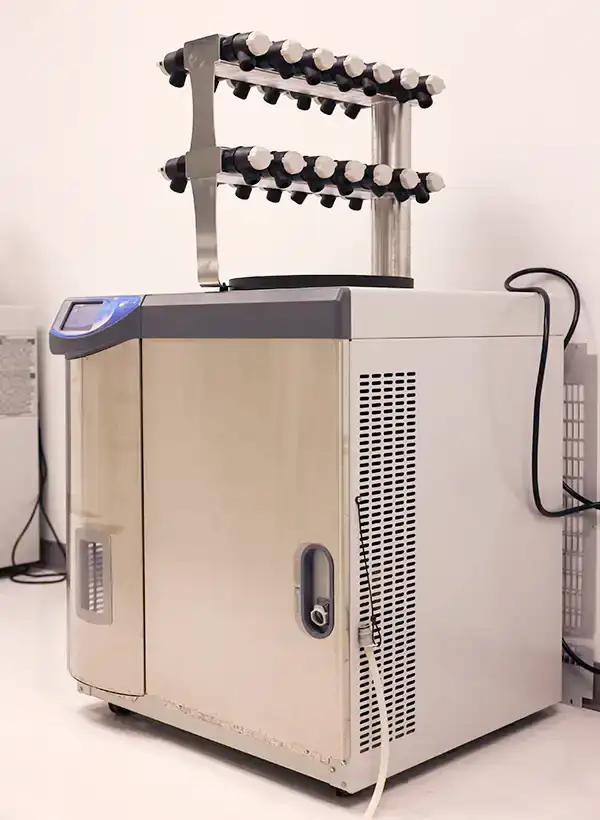
Freeze-drying (or lyophilisation) is a method of preservation that freezes and then dehydrates material. It dehydrates it by sublimating frozen water and removing residual bound moisture through desorption. It’s a delicate, exacting process.
A freeze-drying machine automates it all. It performs the 4 steps for lyophilisation in this order:
- FREEZING – The material is completely frozen (usually in a vial, flask or tray).
- VACUUM – The frozen material is then subjected to a deep vacuum.
- PRIMARY DRYING – Heat energy is then added, causing ice to sublime (i.e., transform directly into vapour or gas without going through the liquid state).
- SECONDARY DRYING – Once ice is removed, a precise amount of heat is added to allow any residual bound moisture within the material to desorb and escape.
However, freeze dryer models designed for laboratory work still vary greatly in size, capacity and possible range of settings. The range of settings each model offers will affect how it executes those 4 steps.
Thus, do not confuse one model for another. If you pair the wrong model for your application, it may lead to:
- operational backlogs due to insufficient freeze dryer capacity
- complete project halt or delay because of incompatibility with intended materials or vessels/containers
- loss of samples or failed process validations
How to Select the Correct Freeze Dryer
To avoid process failures, you need to select a freeze dryer according to two main factors: your target materials and workflow type.
As you move through each section of this guide, check which freeze dryer model aligns most closely with your products or samples and workflow. The model that most often matches your needs is likely your best fit.
Factor 1: Target Materials
First, what type of materials are you lyophilising? These generally fall within the spectrum of 2 types:
1. Crystalline Materials
Crystalline materials have a highly ordered, predictable, three-dimensional molecular structure.
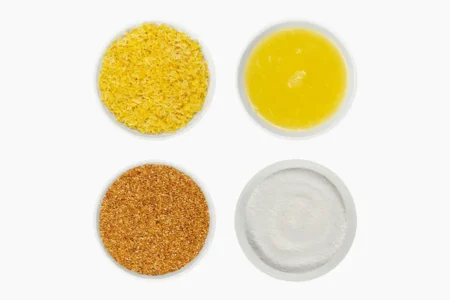
Examples: Mannitol, Glycine, Potassium Phosphate or Sodium Phosphate Buffer Salt Solution Test Formulations
When frozen: A crystalline material undergoes a sharp, distinct phase change at a specific temperature or eutectic point (Te). At this exact point, components of the material (i.e., ice and solute crystals) coexist in equilibrium.
To freeze-dry: Freeze-drying crystalline materials is relatively straightforward.
After a crystalline material is frozen, as long as its temperature remains below its eutectic point (Te) during drying, it will remain stable. Once the ice sublimates, it leaves behind a highly porous structure that makes it easy for water vapour to escape.
Recommended Freeze Dryer Models
Crystalline materials don’t require units with extreme cold traps or complex fluid-filled shelf systems to dry successfully.
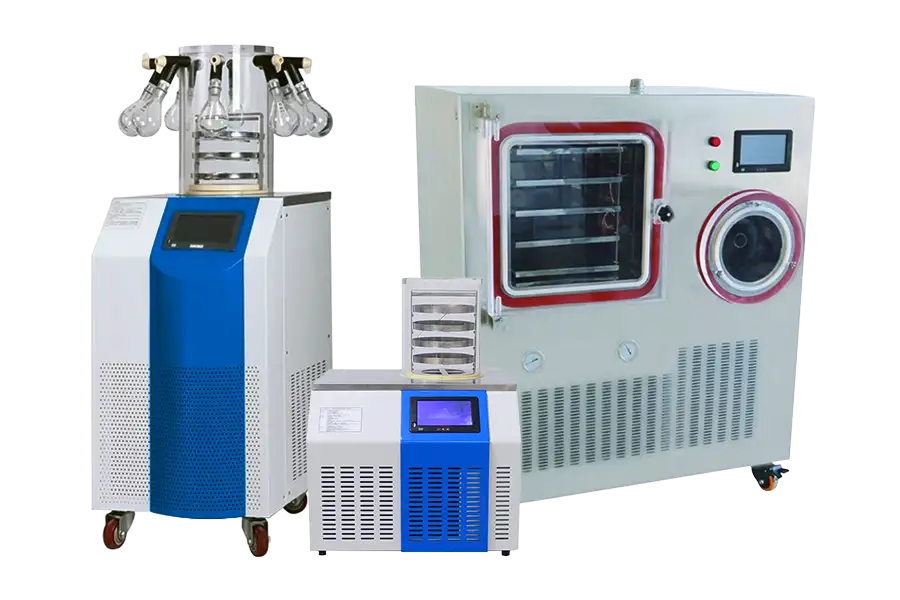
- Benchtop Freeze Dryer – A unit that can sit on any laboratory workbench or countertop. Features a -60º C ice condenser temp and a single-stage refrigeration system. For crystalline materials, that setup adequately provides more than enough of a thermal gradient to capture sublimating water vapour for primary and secondary drying.
- Small-Scale Freeze Dryer – A standing unit with a small footprint. Provides condenser options from -40º C to -70º C (adequate for many standard crystalline freeze-drying applications) and the capacity for bulk volumes of 4 to 10 kg.
2. Amorphous & Mixed-State Materials
Of course, many laboratory freeze-drying applications involve the more complex amorphous or mixed-state materials.
These formulations lack a defined and ordered molecular structure.
- They typically have large, complex molecules that become “tangled” as they freeze, preventing them from forming a neat crystal lattice.
- They may contain components with slow or incomplete crystallisation behaviour.
- They could be a combination of both.
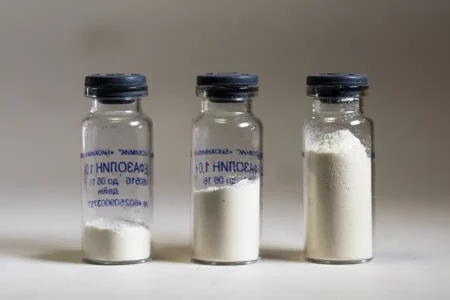
Examples: Sucrose, Cefazolin (beta-lactam antibiotic), Monoclonal Antibodies (mAbs), Taq Polymerase (and other PCR Enzymes)
When frozen: Instead of freezing sharply at a single temperature, these materials gradually become more viscous as they cool. They eventually turn into a rigid, highly immobile, non-crystalline solid called a glass. This transition happens at the glass transition temperature (T’g).
To freeze-dry:

- Frozen amorphous and mixed-state materials are much trickier to lyophilise because their matrices are more susceptible to structural collapse during primary drying. They form a solid “glass” matrix that traps water. If the material’s temperature rises above its collapse temperature (Tc) or the point where it collapses from heat, the “glass” matrix softens and loses structural integrity. The trickiest part is that most amorphous materials’ collapse temperatures are just a few degrees warmer than their glass transition temperature (T’g).
- Many mixed-state formulations benefit from an annealing step. This is where a product is temporarily warmed to a controlled temperature above T’g to encourage crystallisation of specific excipients. This requires direct and accurate control over temperature.
- For both mixed-state and amorphous materials, tight temperature controls and timing for freezing and heat application are key to achieving lyophilisation.
Recommended Freeze Dryer Model
To freeze-dry amorphous materials safely, a system must have a deep-freeze condenser (capable of at least -80º C).This creates a strong vapour pressure gradient. There must also be precise shelf temperature controls to prevent the product from creeping above its collapse temperature.
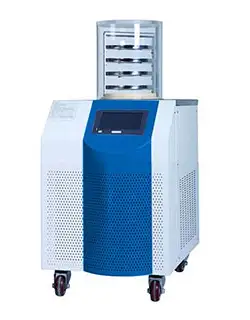
- Pilot Production-Scale Freeze Dryer – A standing unit built for testing pilot commercial productions. Utilises cascade refrigeration technology and intelligent PID (proportional-integral derivative) control to achieve target temperatures as low as -80º C, with precision. Shelf pre-freezing directly in the drying chamber, with a capacity of 3 kg to 20 kg.
- Laboratory Low-Temperature Freeze Dryer – A smaller-capacity standing unit that also achieves -80º C ice condenser temperature to maintain a cold trap gradient, preventing material collapse.
Factor 2: Workflow Type
Which of these workflow types best matches your particular freeze-drying operation?
1. Standard Biomedical R&D with Basic Formulation Screenings
Example Materials: Simple crystalline structures, common bulking agents (mannitol, glycine), stable buffer salts (sodium phosphate), small-molecule antibiotics, and non-dilute aqueous samples.
Recommended Freeze Dryer Model: Benchtop Freeze Dryer
- Critical Specifications: -60º C ice condenser temperature, transparent acrylic drying chamber, adjustable stainless steel shelves, and USB data export functionality.

- Why It Fits: For standard crystalline structures, a -60º C condenser provides an adequate thermal gradient. That drives sublimation efficiently without risking structural collapse. The inclusion of an LCD touch screen with historical data inquiry and USB data export capabilities satisfies fundamental baseline requirements for protocol recording and basic process tracing.
- Operational Benefit: Maximises valuable bench space in multi-use or high-traffic research environments.
2. Advanced Diagnostics of Enzymes and Biologics
Example Materials: Delicate enzymes (e.g., polymerases for PCR kits), monoclonal antibodies (mAbs), blood plasma/serum fractions, attenuated vaccines, and complex formulations utilising amorphous lyoprotectants (sucrose, trehalose).
Recommended Freeze Dryer Model: Low-Temperature Freeze Dryer

- Critical Specifications: -80º C ice condenser temperature, 10 available configurations, high-capacity ice condenser trap, and secure digital data tracking via USB.
- Why It Fits: Enzymes and other biologics are amorphous or mixed-state mixtures. Lyophilising these requires a significant vapour pressure differential between the product chamber and the cold trap. A condenser operating at -80º C lowers the vapour pressure at the trap to an extreme minimum. That allows you to keep the product chamber at lower temperatures (well below the collapse point of sensitive enzymes or antibodies), while still maintaining a continuous sublimation rate.
- Operational Benefit: Minimises the risk of batch-wide collapse during the primary drying phase; helps you achieve compliance with strict clinical diagnostic standards.
3. Pilot Studies & Scale-Up Validation with Mixed-State Formulations
Example Materials: Mixed-state formulations (e.g., a therapeutic protein protected by trehalose alongside a mannitol bulking agent), pilot-scale vaccine trials, or additive development.
Recommended Freeze Dryer Model: Pilot Production-Scale Freeze Dryer

- Critical Specifications: -80º C cascade refrigeration technology, fluid-heated and chilled shelves with accurate temperature control (plus or minus 1º C), shelf pre-freezing functionality directly in the drying chamber, intelligent PID control system, and 3 kg to 20 kg capacity.
- Why It Fits: Unlike benchtop units, pilot freeze dryers utilise fluid-filled shelves. You have direct control over the shelves themselves. You can uniformly ramp or hold shelf temperatures to precise settings. This is essential for annealing, mapping equipment capability curves, and successfully conducting Installation Qualification/Operational Qualification (IQ/OQ) validation runs.
- Operational Benefit: The precise thermal control empowers you to simulate many commercial-scale thermal and process characteristics on a smaller, trial-sized batch.
4. Small-Scale Commercial Operations and Product Development
Example Materials: Small-batch specialty botanical extractions, small-scale diagnostic kit assembly, or preliminary product development runs for small-to-medium businesses (SMBs).
Recommended Freeze Dryer Model: Small-Scale Freeze Dryer
- Critical Specifications: 4 kg to 10 kg load capacities, automated cycling, dual condenser temperature options (-40º C to -70º C), and domestic voltage compatibility (230V, 50 Hz).
- Why It Fits: These systems bridge the gap between laboratory precision and industrial volume. Running on domestic voltage means they can be easily integrated into existing facility footprints without costly electrical overhauls. The fully automated operation allows small businesses to run repetitive, optimised cycles with minimal manual oversight, improving batch-to-batch consistency.
- Operational Benefit: Even with limited space and utilities (and often without chilled water loops or 3-phase high voltage power), you can deal with higher material volumes for freeze drying.
Customise the right freeze dryer to your mission
Have you decided which freeze dryer models best match your materials and workflow? Or are unique operational requirements making that decision difficult?

At Flo-Max Pumps, we can help you deal with the odd key specifications. Our team of engineers can add a few customisations to your freeze-drying system of choice and make it the perfect fit.
As one of Australia’s pump and air control OEMs, we have the engineering expertise to give you:
- Technical guidance for freeze dryer selection
- Custom system configurations
- Vacuum and freeze dryer servicing
- Ongoing technical support and troubleshooting
Explore our range of Freeze Dryers or contact our team for expert advice. We’ll ensure your chosen unit delivers the reliability you need for your set of applications.