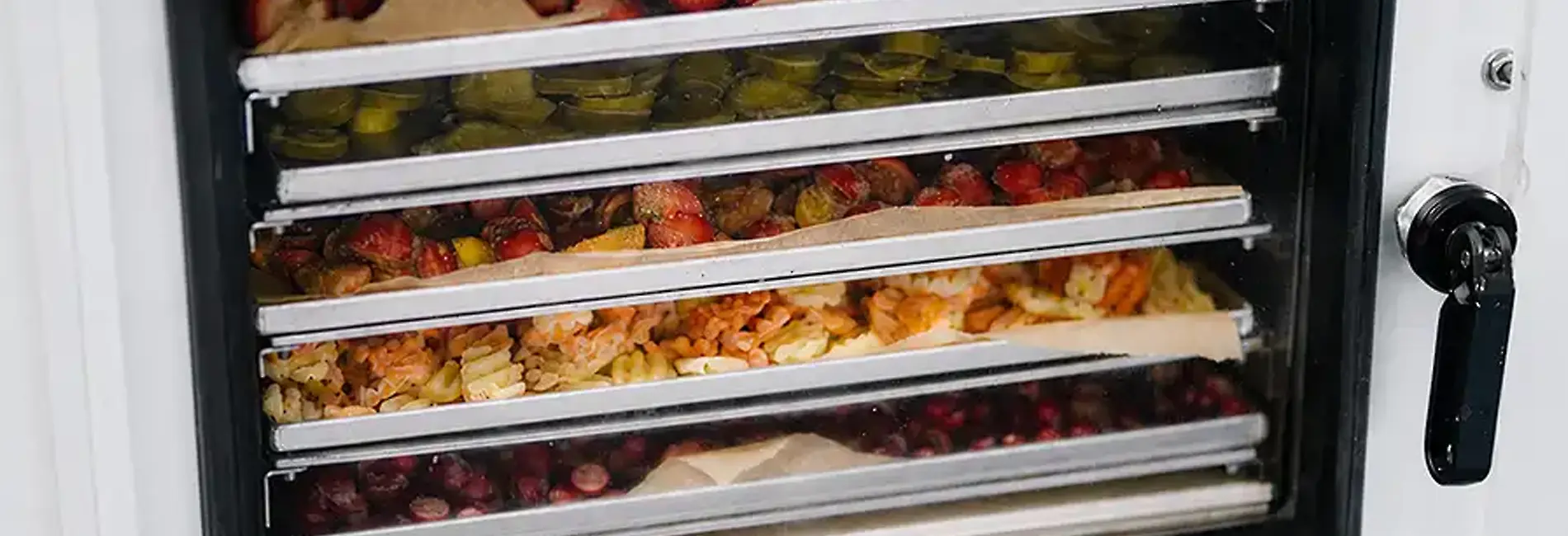
Congratulations, you’ve developed a freeze-dried food product with great commercial potential. Demand for it is rising. Now, you must scale up the freeze-drying process for mass production. And you’ll need a new industrial freeze dryer to go with it.
Purchasing equipment as specialised as a freeze-drying system is unfamiliar for many procurement and operations managers. If you’re one of them, this quick guide can help you begin evaluating a freeze-drying process for a scale-up, before selecting the right industrial freeze dryer to match.
Understanding the Scale-Up Challenge
Whether it’s for launching a new line or meeting increased demand for an existing product, scaling up commercial production for a niche category like freeze-dried food has specific challenges.
Nevertheless, there are 3 important aspects it shares with any other scale-up.
1. Proper coordination between departments
A successful scale-up is typically the work of a cross-functional team. The team includes representatives from different departments.
| Department Representative | Core Responsibility in the Scale-Up |
|---|---|
| R&D (Research & Development) | Transfers the technical “recipe” or product/process specifications and explains critical material tolerances. |
| Engineering (Process/Automation) | Designs the new line layout, selects/modifies equipment, and handles the physical installation. |
| Procurement / Sourcing | Negotiates vendor contracts for the new machinery, secures long-term raw material supply chains, and manages the CapEx budget. |
| Operations / Production | Ensures the new setup is practical for operators, coordinates shift training, and fits within the physical plant footprint. |
| Quality Assurance (QA) | Ensures the new equipment and manufacturing process comply with the company’s food-safety and quality systems and applicable requirements. |
| Executive Management | Tracks the overall return on investment (ROI) and ensures the scale-up capacity matches market demand forecasts. (Typically involves people from Business Development and Finance in the process.) |
Proper coordination or technology transfer (“knowledge transfer”) between these departments is key to finding the right industrial freeze-drying system.
This is especially important during your product’s pilot freeze-drying tests and the evaluation of proposed new equipment. (More on these later.)
2. Intervening factors that act differently at larger scales

Scaling up any manufacturing process is rarely as simple as increasing batch size and shifting to larger equipment.
The same is true for commercial freeze-drying. As production volumes increase, several factors may behave differently (e.g., heat transfer, shelf loading, refrigeration demand, vacuum performance and drying time). These can affect food product quality and process consistency, giving you results that are different from those previously produced by your lab staff.
Thus, to scale up the freeze-drying process, you and your scale-up team must:
- Carefully establish and verify the appropriate conditions for each stage of the freeze-drying process (i.e., freezing, primary drying and secondary drying) needed to achieve the required product quality
- Identify which factors could (and do) vary when you perform the process at a larger scale
- Pinpoint the industrial freeze dryer technical features necessary for managing these factors and reproducing quality outcomes, accounting for equipment differences between laboratory freeze dryers and commercial equipment
3. Balancing technical and business requirements

The freeze-drying system you select must consistently deliver:
- the required throughput
- repeatable product quality
- operational efficiency
- long-term reliability
- compliance with food safety and other applicable standards
However, your choice must also balance commercial realities. That means you should ensure:
- the new system suits the production area’s space limitations and any installation constraints
- it is an acceptable capital expenditure
- its usage and upkeep are within projected operating costs
- the system can aid future production expansion plans
- the chosen supplier provides excellent technical support
Procuring a new industrial freeze dryer is also a future-defining decision. What you acquire today may also support other freeze-dried food products you develop in the future. In other words, your choice of model will influence your production costs, manufacturing capacity and business growth for many years.
So rather than simply asking, “What is the biggest freeze dryer we can afford today?” your question should be, “Which freeze-drying system best supports the next stages of our business?”
Evaluating the Scaled-Up Process
With all this in mind, here is a general rundown of what you should evaluate to define your technical and business requirements for the actual mass production of your freeze-dried food product.
Note: Australian food manufacturers should also confirm the food-safety, hygienic design, cleaning, documentation and other regulatory requirements applicable to their particular products and operations. The requirements for a freeze-dried fruit or snack product, for example, may not necessarily be identical to those for another type of food.
1. What Changes When The Freeze-Drying Process is Scaled Up?
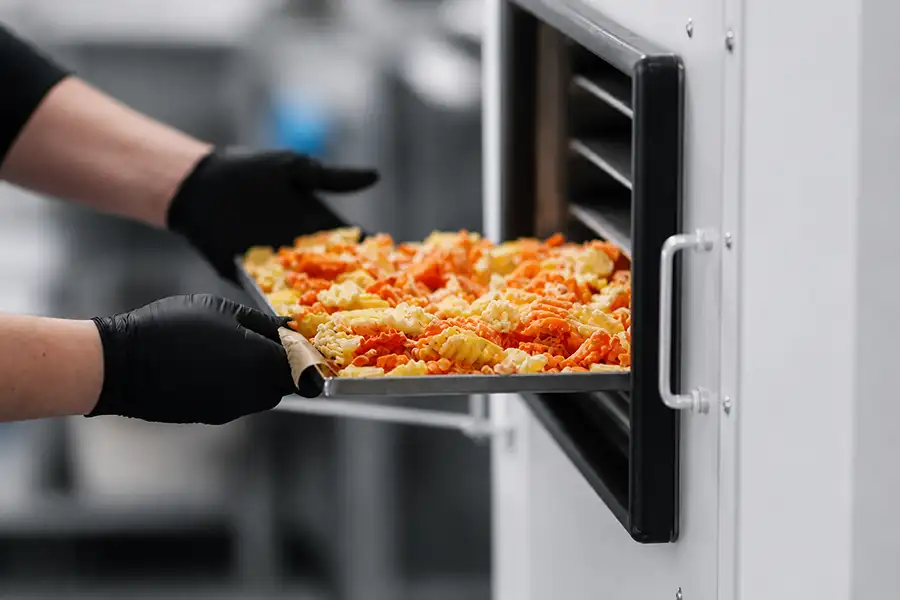
Your laboratory production trials can demonstrate that:
- the product can be successfully freeze-dried;
- critical quality attributes can be achieved;
- and the chosen freeze-drying cycle is technically feasible at laboratory scale.
But when you transfer those trials to commercial-scale production, you may encounter changes in (or different requirements for) variables such as:
- material preparation time
- product loading density and shelf loading (number of shelves, loading method per shelf, etc.)
- condenser loading
- refrigeration/freezer demand
- required vacuum performance
- loading and unloading times
- operator workflow
- production scheduling
- cleaning procedures
Any changes in these variables can directly or indirectly affect the quality of the food product and the efficiency of the production process.
In short, you must still answer important questions, such as:
- Can we maintain the same product quality when producing hundreds of kilograms rather than a few kilograms? How does the freeze-drying process for this food product behave when scaled up to a larger batch? Any issues that make the outcome different from how it was in the laboratory?
- Is the outcome the same each time we repeat the scaled-up freeze-drying process? Or does it vary with each attempt?
- Is there any loss or wastage (i.e., material damage incurred from unsuccessful freeze-drying) by the scaled-up process? What percentage of the material do you waste on average?
- Can you identify the causes of any differences in outcomes between the lab-tested freeze-drying process and the scaled-up version? Which variables (e.g., material preparation, shelf loading method, vacuum performance, etc.) of the freeze-drying process should we modify or tightly control to target those causes?
- Can a particular industrial freeze dryer model provide features that help you successfully manage or minimise what’s causing the differences in outcome?
Action:
You should consider a thorough evaluation of how the scaled-up process behaves in larger-scale equipment. Have pilot production-scale freeze-drying tests conducted. (Your product-development personnel should facilitate these tests with the help of engineers and operations managers.)
Wherever practical, pilot-scale trials/tests should inform the final equipment specification. In many projects, however, preliminary discussions with suppliers may also begin while you conduct pilot-scale tests. That can also help you refine equipment specifications and plan for future production needs.
Tips:
- Don’t have freeze-drying equipment large enough for large trial productions? Some companies that embark on a freeze-dried food product line for the first time will outsource the work to contract product developers or suitable pilot facilities. These organisations can do the R&D and/or pilot-scale production tests for you, then transfer the knowledge to your team.
- How do you fill in any remaining gaps in your team’s technical knowledge of freeze-drying equipment? Source your industrial freeze dryers from a supplier with experienced in-house application engineers (like our experts here at Flo-Max Pumps).
2. What Is the Target Production Output?
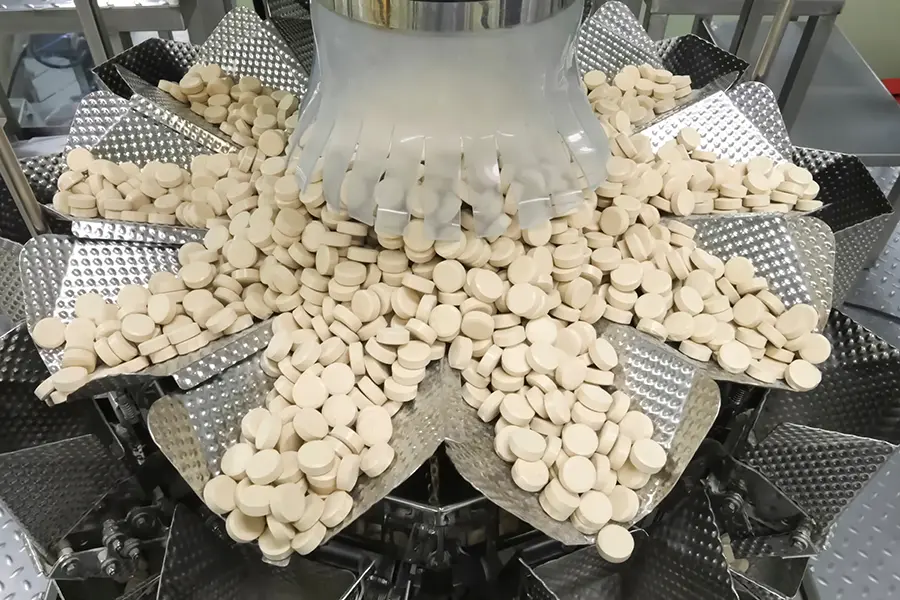
Forecast demand should be realistic rather than optimistic. But unsurprisingly, when you try to define your target production output, you’re likely to encounter conflicting departmental goals.
That’s because the people in Marketing and Business Development naturally aim for future growth opportunities, while Engineering and Operations must ensure the selected equipment delivers only what’s efficient and economical. Meanwhile, Finance warns them to minimise expenditure.
Nevertheless, you need a consensus. A stronger basis for equipment selection is to align commercial expectations with demonstrated manufacturing capability. Ideally, you should do this before requesting suppliers for proposals.
Action:
Here are a few suggestions on how to ground production targets in reality:
- Run a Process Scale-Up Review: Where technical questions remain, have the development team review the critical product and process parameters established during laboratory testing and determine how they translate to the larger freeze dryer. This may include relevant product temperature limits, freezing behaviour, heat- and mass-transfer characteristics, primary- and secondary-drying conditions, and the production dryer’s maximum sublimation rate and controllable pressure range. You can use pilot-scale studies (where appropriate) to refine the cycle before commercial production.
- Think in terms of a 3-tier compromise matrix. Based on what the tests show, get everyone to define what they think should be the non-negotiable minimum, optimal, and “stretch” targets. Then peg the shared middle ground and get top management approval.
- Translate sales forecasts into “Net Operating Days.” Account for maintenance, cleaning, and defrosting to get a true required batch capacity.
- Issue your proposals with strict performance metrics. When approaching candidate freeze dryer manufacturers (like Flo-Max Pumps), give them enough information to assess your actual process duty. Depending on your food application, this may include:
- required shelf area and loading pattern
- water load
- expected sublimation rate
- operating pressure range
- condenser capacity
- shelf-temperature range and uniformity
- heating and cooling performance under load
- cycle duration and required throughput
- maximum sublimation rate and minimum controllable pressure (for more technically demanding scale-ups)
Tip:
Make sure your team can clearly answer the following questions:
- What freeze-drying cycle duration has already been verified?
- What are the required freezing temperatures and how much freezing capacity do you need
- How many kilograms of finished food product do you require each week?
- How many production days in a week are available?
- How many batches can you realistically complete each day?
- What throughput can be achieved while remaining within the required product-quality limits?
3. How Will the Freeze Dryer Fit Into The Larger Workflow?
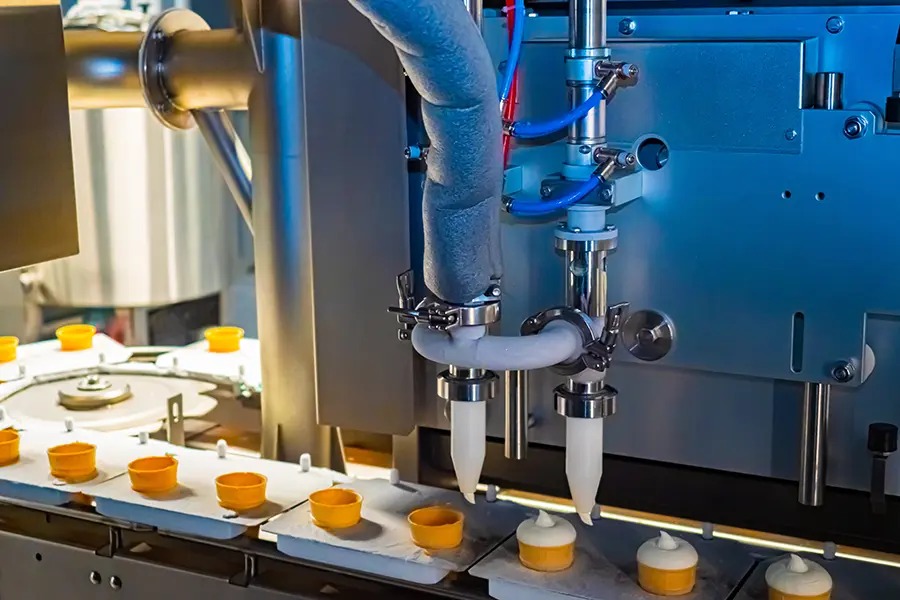
Is the new industrial freeze dryer just one component of a much larger food manufacturing process? If so, how well will it work with the rest of that process?
Consider the following:
- Can our manufacturing area and existing utilities support the addition of a large freeze-drying system? What adjustments do we need?
- What kind of preparation do we need before raw food materials are ready to be placed into the freeze dryer? Depending on the product, could this involve washing, cutting, cooking, blending, portioning, pre-freezing or another automated or manual process?
- How much will that preparation cost? How many hours of automated processing or manual labour do we need for that preparation?
- How will food coming from the freeze dryer be systematically unloaded and moved on to the next step in the manufacturing process (e.g., additional processing, packaging, labelling, storage or distribution)?
- Will the pre-freeze-drying material need cold storage? What storage conditions will the finished freeze-dried food require? How much refrigeration or storage capacity will we require?
- What kind of additional manpower or supervision do we need to successfully incorporate the freeze-drying system into the process and maintain it? How much labour will loading and unloading require? Will you end up needing more technology and/or people to run the integrated process? What level of automation will improve production efficiency?
- What adjustments must we make for technical maintenance, food hygiene and cleanliness throughout the whole process? Can production continue if and when we require maintenance?
Action:
Have your team evaluate how the scaled-up freeze-drying process (and the handling of freeze-dried food) will affect the rest of the production process and business. Don’t overlook:
- material handling
- upstream and downstream processing
- packaging systems
- cold storage/warehouse logistics
- food safety and quality assurance
- production scheduling
- cleaning procedures
- maintenance accessibility
- overhead costs
For food manufacturers, this wider workflow review is particularly important. Increasing freeze-drying capacity will not necessarily increase total plant output if preparation, pre-freezing, packaging or another upstream or downstream operation becomes the new bottleneck.
Selecting and Evaluating Industrial Freeze Dryers
Once your requirements are established, deciding which potential industrial freeze dryer suppliers and models to target becomes easier.
1. Search and List: the Appropriate Freeze Dryers
Start by asking your candidate suppliers to give you a list of industrial freeze dryer models suitable for your food application.
Tip:
Of course, suppliers can and will provide you with detailed technical specifications for each model. But it would be even better if they could also advise you which model is frequently used or recommended for which production size or stage. It would help make your choices clearer.
For instance:
| Production Stage* | Typical Situation* | Illustrative Flo-Max Options* |
|---|---|---|
| Early commercialisation; pilot production | Transitioning from laboratory or pilot-scale testing to commercial manufacture | FDB10, Pilot Scale Freeze Dryers |
| Small commercial production | Consistent commercial batches with room for modest growth | FDB20 |
| Growing production | Increasing throughput while maintaining product quality | FDS50/100 |
| Medium-volume manufacturing | Larger commercial production and expanding product lines | FD200/300 |
| High-volume manufacturing | Established industrial production | FD500 |
| Large-scale industrial manufacturing | High-capacity or large-batch commercial operations | Premium Production Scale Freeze Dryers |
*Note: These are only illustrative examples. Final equipment selection should always be based on verified production requirements, engineering assessment and consultation with experienced equipment specialists. To see more detailed technical specifications for each Flo-Max industrial freeze dryer model, contact our team.
2. Questions To Ask A Supplier

When you’ve narrowed down your selection to a few models, ask a supplier for a demonstration, factory inspection, factory acceptance test (FAT), reference installation or detailed engineering review where available.
Although every food manufacturer’s requirements differ, the following questions provide a useful starting point during supplier discussions. For each candidate freeze dryer model, ask:
Production Capacity
- What is this model’s production volume capacity for our type of food product and loading arrangement?
- Which food-industry clients or applications have previously used this model? (And if you have this information: at what production batch sizes and schedules have they used this model? Is their production seasonal or continuous?)
Product Requirements
- Can this model be made to accommodate multiple food product types? Or can it only be configured for one or two similar products?
- What if we have drying recipes for two freeze-dried food products that vary significantly?
- What if our product requires particularly low temperatures or specialised process control?
- Are the proposed chamber, shelves, trays and other relevant surfaces appropriate for our food-safety and HACCP plan requirements, where applicable?
Facility Requirements
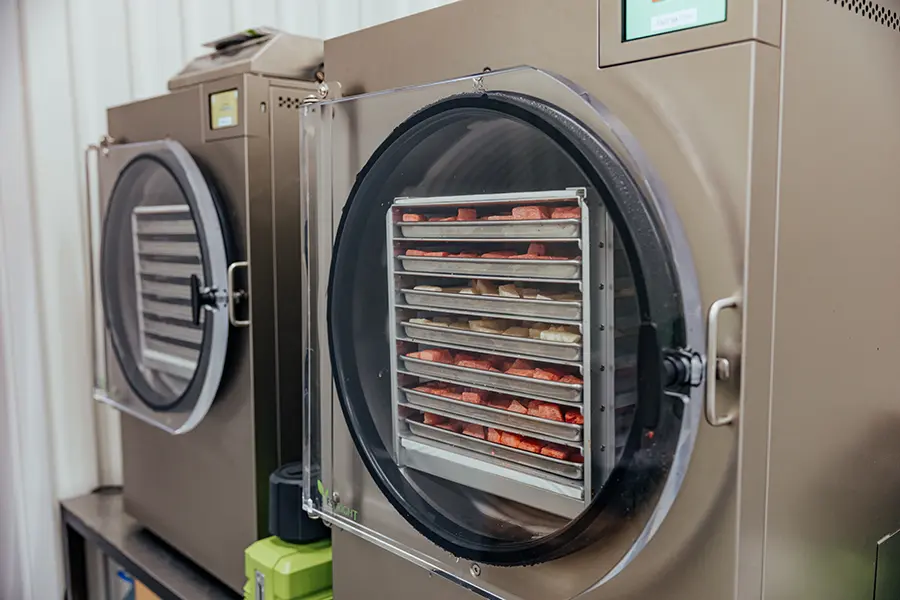
- What electrical capacity is required to run this model at our facility?
- What is its required floor space or footprint? (Note: remember to consider space for operations as well as maintenance.)
- Will this require input of chilled water and compressed air? Where?
- Can this equipment be delivered into our building and installed without major structural modifications?
Operational Requirements
- How easy is routine maintenance?
- How often must servicing be performed?
- What operator training is included?
- What documentation accompanies this equipment?
- How quickly are replacement parts available?
- How will routine cleaning be performed, and which areas require operator access?
Supplier Requirements
Finally, evaluate the supplier. Ask your own questions to discover:
- Does the supplier understand food-manufacturing applications?
- Have they completed similar installations?
- Can the equipment be customised, if required?
- Is installation support available?
- Will commissioning assistance be provided?
- Is local (Australian) technical support available after installation?
3. Evaluate the Total Cost of Ownership
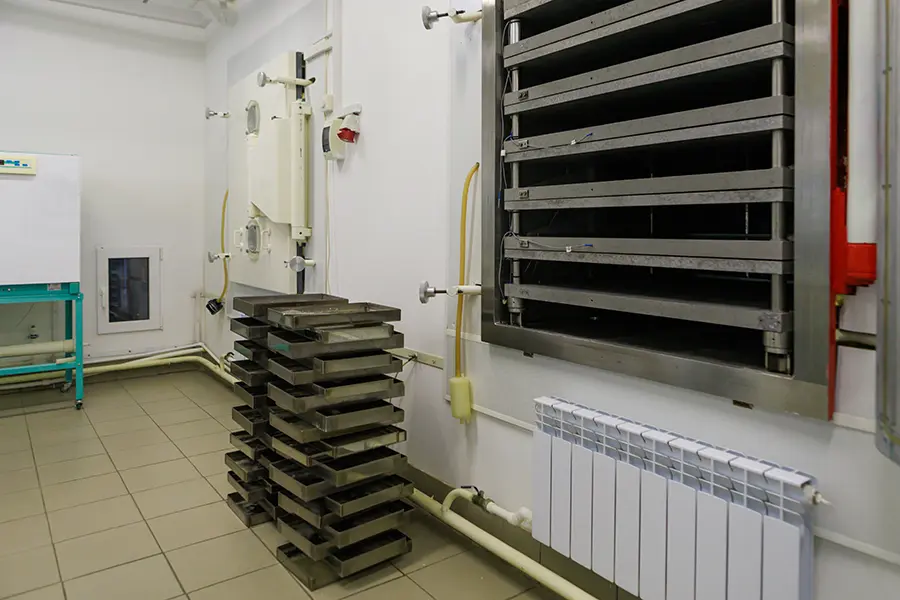
Before you finally zero in on that one freeze dryer model, make sure you’re evaluating it beyond its purchase price and current usefulness.
Major procurement decisions (such as an industrial freeze dryer) should consider total cost of ownership (TCO), rather than acquisition cost alone.
A useful way to approach this is to consider the equipment’s entire lifecycle. Industrial freeze dryers are long-lived capital assets that may remain in service for many years. Consider what the capital costs (from initial purchase, installation and testing) and operating costs (e.g., power consumption, servicing & maintenance, cleaning, labour, etc.) could be for that entire period.
How Will Technical Support Bolster Long-Term Reliability?
Beware: a highly sophisticated freeze dryer can become an expensive bottleneck (or even a white elephant!) if replacement parts, technical assistance or qualified service engineers are difficult to obtain.
You should therefore evaluate:
- availability of local technical support (preferably from the supplier, not just your engineers)
- spare-parts inventory
- expected service response times
- availability of preventive maintenance programs
- operator training
- commissioning assistance
- required electricity (i.e., power for refrigeration and vacuum pump)
Over the equipment’s lifetime, these factors can outweigh relatively small differences in purchase price.
Can You Allow Room for Future Growth?
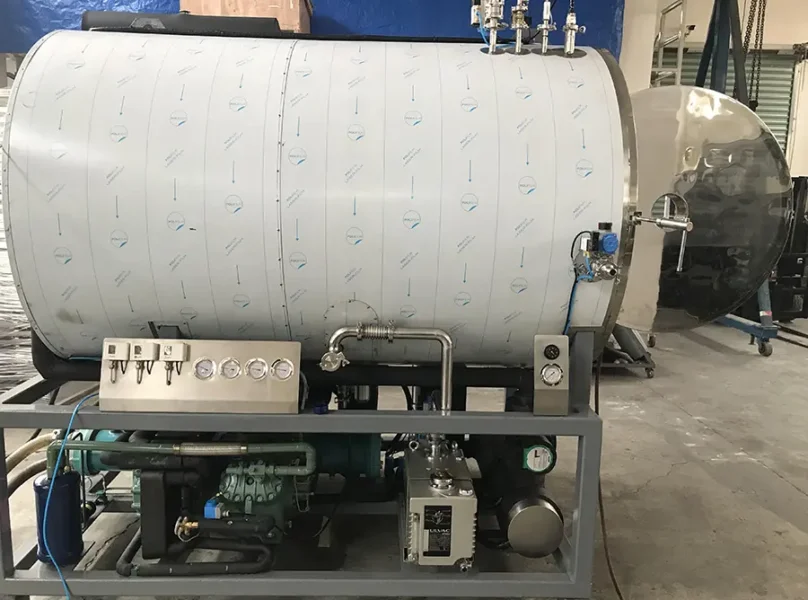
Another common mistake is purchasing equipment that precisely matches today’s production requirements. Always remember that food manufacturing businesses rarely remain static.
- New potential related customer niches are acquired
- Export markets develop
- Product lines can expand
- Seasonal demand can fluctuate
Moreover, industrial freeze dryers are major capital investments that should remain in service for many years. Thus, choosing equipment with modest additional capacity may reduce your need for expensive equipment replacement a few years later.
So consider the following before you purchase that freeze dryer model:
- Is demand expected to increase significantly over the next five years? How will production volumes increase accordingly?
- Are export markets planned?
- Will there be new food products in the pipeline that will also require freeze-drying?
- Could contract manufacturing become an additional revenue stream?
- Will manufacturing eventually operate multiple shifts?
Action:
Think ahead. Have your team evaluate whether additional shelf area, higher condenser capacity or greater production flexibility may justify a slightly larger investment today.
But conversely, make sure you don’t end up purchasing significantly oversized equipment based on unrealistic production forecasts.
Successful equipment selection involves an appropriate balance between present demand and anticipated future growth.
Tip:
Are you running a small-to-medium operation because you’re targeting a niche food market, for now? Don’t immediately dismiss the extra technological features on pricier freeze dryer models (such as intricate programmable control systems and automated process monitoring), simply because they’re more expensive.
These may seem unnecessary features today. But if and when your business grows, you’ll rely more on automation to improve consistency and reduce labour requirements. Carefully consider if investing in more tech features now can significantly improve production repeatability in the future.
Scale up your food production with our freeze-drying experts
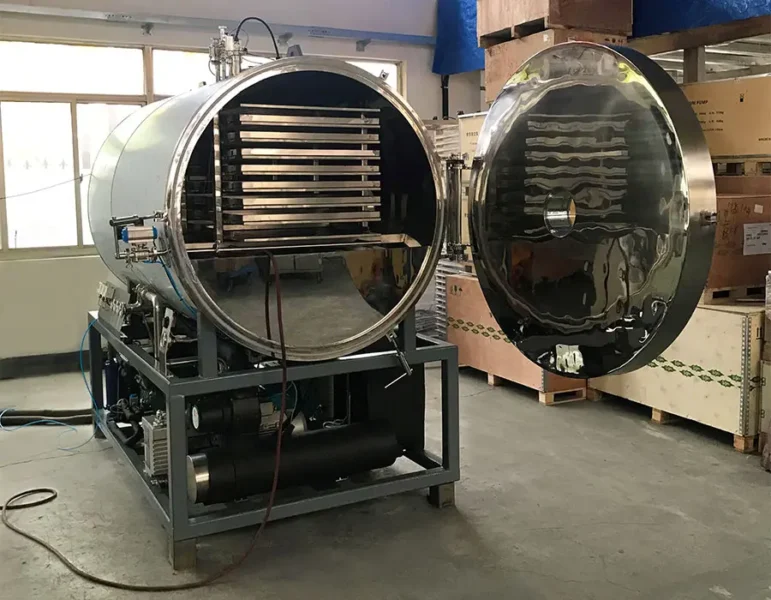
Going from laboratory development to a commercial food production line requires specialised engineering and deep technical expertise. At Flo-Max Pumps, we back our equipment with our decades-long experience in pump engineering and freeze-drying.
Whether you’re building a new food-production facility or upgrading to new, custom-engineered commercial freeze-drying machines, our team can provide you with the end-to-end local engineering support you need.
Ready to release your freeze-dried food product to the market?
Contact our engineering team today. Let’s discuss your specific throughput targets, material dynamics, and utility infrastructure requirements. We’ll customise the right industrial freeze dryer for your operations.