
Your pharmaceutical company wants to invest in its own industrial freeze-drying technology. But before you reach out to equipment suppliers for proposals, have you clearly defined what the freeze-drying system needs to do?
To find the right industrial freeze dryer, you must first translate your needs, process requirements and facility constraints into a technical specification that suppliers can work with. Here’s a guide on how you can prepare this.
What A Technical Specification Should Tell A Supplier
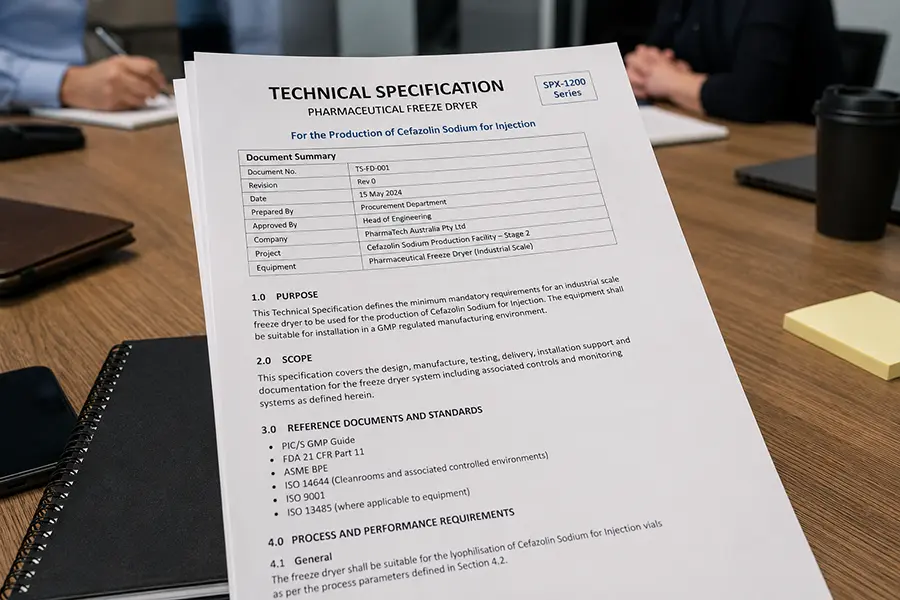
A technical specification is a written summary that describes the required performance, functionality, interfaces and other technical characteristics of proposed equipment.
Depending on the organisation and project, these requirements may form part of a User Requirements Specification (URS), functional specification, equipment specification, tender documentation or another controlled project document.
The terminology and document structure may vary according to the type of equipment it describes. But its underlying purpose remains the same: to translate your manufacturing needs into requirements your equipment suppliers and internal stakeholders can easily understand and respond to.
So when it comes to industrial freeze dryers, a useful technical specification should answer questions such as:
- What products will be freeze-dried?
- What batch sizes and production volumes are required?
- What process conditions must the equipment achieve and control?
- How will the product be loaded?
- What refrigeration, condenser and vacuum performance is required?
- What instrumentation and controls are needed?
- What process data need to be recorded?
- What materials and construction requirements apply?
- How will the equipment be cleaned?
- What utilities are available?
- What documentation must the supplier provide?
- What testing, commissioning and qualification support will be required?
- What service and maintenance requirements need to be considered?
Your answers will give prospective suppliers a much clearer idea of which industrial freeze dryer model suits your application.
Reminder: This presumes that the specifications you provide are based on pilot production tests your R&D team has already done or is currently conducting.
The Industrial Freeze Dryer Technical Specification Guide
This guide is a long checklist of details for you to consider. Go through it, decide which details are applicable or not to your business, and compose your technical specification accordingly.
1. Summarise the Intended Use

Begin with a summary of what the freeze dryer will actually do.
This may include:
- the type or types of product
- whether material will be processed in trays, vials or another configuration
- whether the equipment is intended for development, clinical, pilot or commercial production
- expected batch frequency
- whether multiple products will share the equipment
- whether the system will operate in campaigns
- expected operating hours
- anticipated future uses
Reminder:
You don’t have to disclose the full details on any of your proprietary product formulations. However, you shouldn’t withhold design-critical data, either, to the point of preventing suppliers from proposing appropriate systems. Solution: Use standard confidentiality agreements where necessary.
2. Define the Regulatory Context
Identify your operating regulatory and quality environment.
Depending on your product, its manufacturing may fall within Australia’s therapeutic-goods framework, food regulation or another applicable regime. (For medicines subject to Australian GMP requirements, consider the relevant TGA manufacturing principles and PIC/S Guide to GMP.)
It’s better if you specify this for a freeze dryer supplier, rather than simply using a generic “pharmaceutical-grade” label in your technical specification.
3. Define the Product and Load in Detail
It would help your supplier make proper equipment recommendations if your specs had details, such as:
- product quantity per batch
- initial water or solvent content (estimated, per batch)
- product concentration, where relevant
- fill volume or product depth
- container or tray dimensions
- number of containers or trays
- total usable shelf area required
- required shelf spacing or loading clearances, where relevant
- permissible load per shelf, where relevant
- expected ice load
- loading configuration
- product temperature constraints
Reminders:
- Product load and condenser ice capacity are not the same measurement. The amount of ice that a condenser can capture does not automatically state how many kilograms of a particular product formulation can be processed successfully in a batch.
- If you’re planning to use the freeze dryer for several products, provide representative minimum, normal and maximum loads for each (where practical).
4. Define the Required Freeze-Drying Process
Next, describe the operating envelope the freeze dryer needs to support. Useful information can include:

- freezing requirements
- minimum and maximum shelf temperatures
- required heating and cooling rates
- required shelf-temperature uniformity or control tolerance, where process-critical
- required chamber-pressure range and control performance
- evacuation requirements, where process-critical
- expected primary-drying conditions
- expected secondary-drying conditions
- approximate cycle duration
- product-temperature limits
- expected condenser/ice load and, where relevant, peak vapour load
- any controlled back-filling requirements
Reminder: You don’t always need to convert your freeze-drying process settings into rigid equipment-design instructions. A knowledgeable manufacturer can recommend the proper design based on your settings. They might even achieve your required outcome through a different engineering configuration.
Where possible, make sure you can distinguish between:
- Mandatory performance requirements — what the system must achieve.
- Preferred features — characteristics that would be beneficial but are negotiable.
- Supplier-designed solutions — areas where the supplier should propose how the requirement will be achieved.
That distinction can prevent the specification from becoming unnecessarily restrictive.
For example, rather than specify a particular vacuum pump solely because it was used on smaller equipment, describe the process performance you require. Allow the supplier to explain how the proposed vacuum system will achieve it.
5. Specify Instrumentation, Controls and Data Requirements
Controls should reflect both production needs and the applicable quality system.
Consider requirements for:

- process monitoring and control
- recipe management
- alarms, interlocks and operator access
- batch records, data logging, trending and export
- audit trails and other electronic-record requirements, where applicable
- backup, recovery and integration with site systems, where required
Reminder:
For systems operating within a regulated pharmaceutical environment, electronic records and computerised system requirements may need additional consideration. Make sure to check with
your Quality, validation, engineering and IT personnel (where appropriate) what they would need.
6. Define Construction and Product-Contact Requirements
The intended product and cleaning regime should drive construction requirements.
The specification may address:
- required materials of construction and product-contact materials
- surface finishes, where required
- seals, gaskets and chemical compatibility
- corrosion-resistance requirements
- construction requirements affecting cleaning, inspection or the controlled environment
- required material or surface-finish certification
7. Define Loading, Stoppering and Back-Filling Requirements
How the product enters and leaves the freeze dryer can materially affect equipment design.
For tray-loaded bulk material, define tray dimensions, quantities, handling arrangements and any restrictions associated with loading.
For vial applications, additional requirements may include an in-chamber stoppering system and the associated shelf movement or hydraulic arrangement.
Some products may also require the chamber to return to atmospheric pressure using filtered air, nitrogen or another inert gas.
If back-filling is required, identify the intended gas and any filtration, pressure, connection or control requirements that are important to the application.
(Note: Flo-Max’s large production freeze-dryer range includes systems with inert-gas or nitrogen back-filling options. This is an example of a requirement that should be established before the final machine configuration is selected.)
8. List Cleaning and Contamination-Control Requirements
Cleaning requirements should be determined by the product, process and applicable quality system.
Consider:
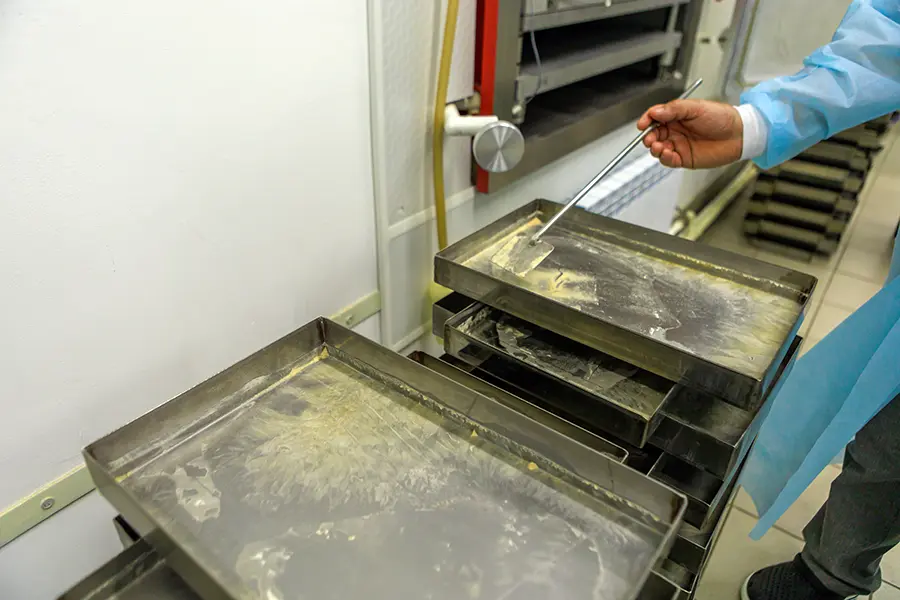
- the required cleaning approach
- requirements between products or campaigns
- cross-contamination risks
- if you require Clean-in-Place capability
- if you need Steam-in-Place capability
Do not automatically specify sophisticated cleaning or sterilisation systems simply because you’ll be using the equipment for pharmaceutical production.
Their necessity should be based on the actual application and contamination-control strategy.
Where sterile manufacturing is involved, substantially more stringent equipment, environmental and contamination-control requirements may apply. Your company should establish these with appropriately qualified quality and process specialists.
9. Define Facility and Utility Interfaces
A technically suitable freeze dryer can still be unsuitable for a facility.
Provide prospective suppliers with the relevant site constraints and available utilities.
These can include:
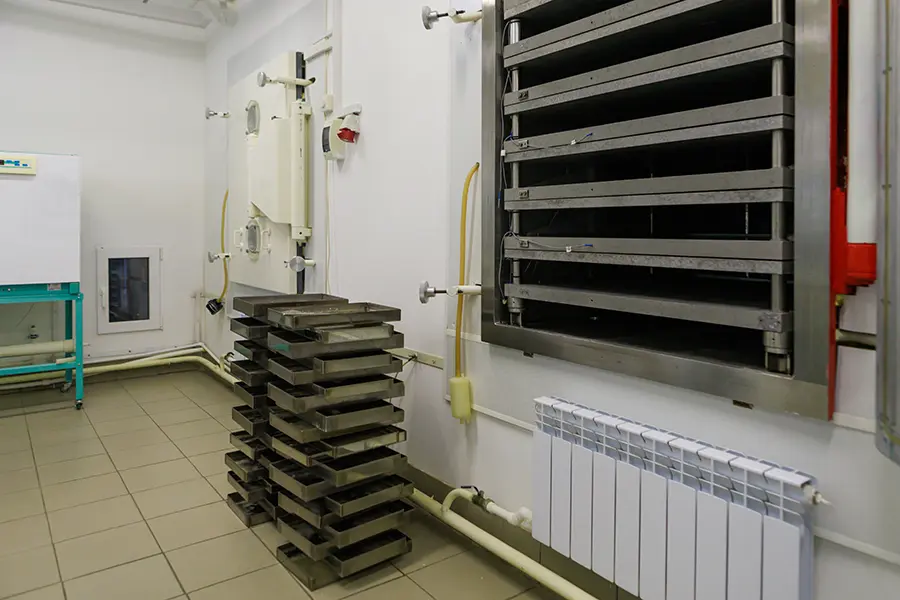
- electrical supply, cooling water, compressed air, process gases, drainage and ventilation or heat-rejection provisions
- room temperature and humidity
- available floor area and ceiling height
- floor loading
- doorways, access routes and required service clearances
- cleanroom or controlled-environment interfaces, where applicable
For larger equipment, delivery access deserves particular attention.
A freeze dryer that fits comfortably in its final room may not necessarily fit through the route required to get it there.
Ask the supplier to identify utility consumption, connection points and installation requirements as part of the proposal.
10. Specify Safety Requirements
The specification should identify applicable site and equipment-safety expectations, including relevant Australian WHS considerations, applicable standards, isolation and maintenance requirements and any site-specific engineering or safety standards.
If the site has its own engineering or safety standards, provide them with the specification rather than expecting the supplier to infer them.
11. Define Required Supplier Documentation
Documentation is important for both operation and future maintenance.
Identify what needs to be supplied with the machine and, where relevant, when it needs to be available.
Depending on the project, this can include:
- design and engineering drawings
- equipment, component and instrument documentation
- material and calibration certificates
- software and controls documentation
- operating and maintenance documentation
- recommended spare-parts and preventive-maintenance information
- certificates, declarations and test records required for the equipment
For regulated applications, determine documentation requirements with the quality and validation teams before you place the purchase order.
It is much easier if you require specific documentation contractually than to discover after delivery that it was never included in the supplier’s scope.
12. Define Testing, Commissioning and Qualification Support
The specification should state how the organisation expects to establish that the supplied equipment meets its requirements.
This can include a Factory Acceptance Test (FAT) before shipment and a Site Acceptance Test (SAT) after installation.

Where qualification is required, the project may also need to address:
- Design Qualification (DQ)
- Installation Qualification (IQ)
- Operational Qualification (OQ)
- Performance Qualification (PQ)
The purchaser and supplier should clearly establish who is responsible for preparing protocols, performing tests, resolving deviations and providing supporting documentation.
The supplier may provide substantial qualification support, but responsibility for the manufacturer’s validated process and quality system remains with the manufacturer.
Acceptance criteria should be traceable to defined requirements wherever practical.
If your specification states that shelf-temperature uniformity, vacuum performance or another characteristic must meet a particular value, you should also establish how you need that requirement tested (and under what conditions).
13. Specify Maintenance, Spare Parts and Technical Support
An industrial freeze dryer becomes a production asset. Consider maintainability before you purchase.
Ask prospective suppliers to address:
- preventive-maintenance and specialist servicing requirements
- expected consumables and critical spare parts
- spare-parts availability and long-term support
- controls support and remote diagnostic capability, if required
- response times and availability of Australian technical support
- operator and maintenance training
For equipment that may remain in operation for many years, long-term parts and technical support can be as important as initial equipment performance.
A Few Valuable Tips for Procurement Managers
1. Make the Specification Measurable
One of the most useful improvements you can make to a technical specification is to replace subjective wording with measurable requirements.
For example:
Weak:
“The freeze dryer needs good temperature control.”
Better:
Define the required shelf-temperature range, control tolerance and the conditions you require.
Wherever practical, express important requirements in terms that suppliers can respond to, and that can later form the basis of equipment testing and acceptance.
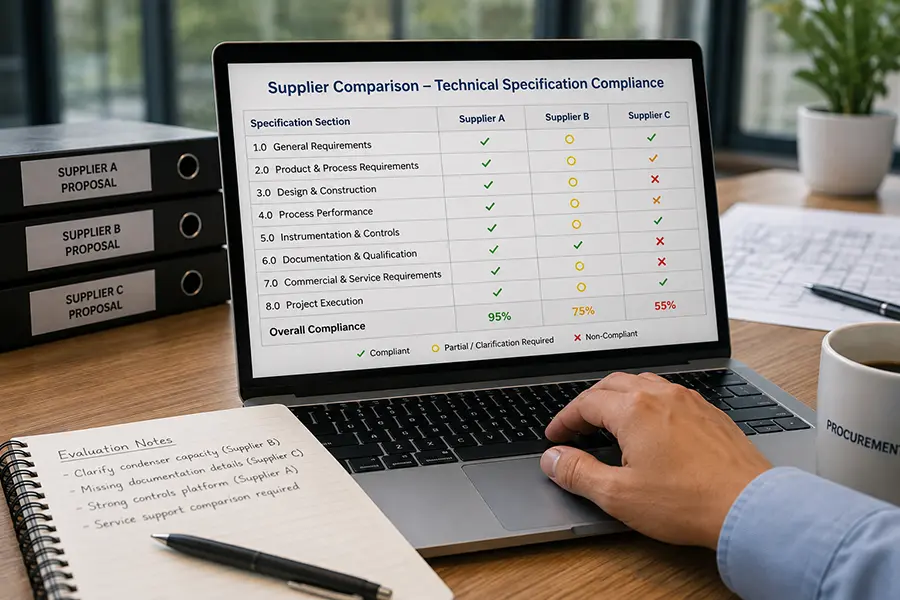
2. Use the Specification to Compare Supplier Responses
Once issued to prospective suppliers, your technical specification becomes a common reference point.
Ask each supplier to respond systematically to its requirements and clearly identify:
- compliant requirements
- proposed alternatives
- exceptions
- assumptions
- optional features
- information requiring clarification
This makes differences between proposals much easier for you to spot.
One supplier may have excluded important functionality, documentation or installation work, while another may have interpreted a requirement differently or proposed an alternative technical solution that deserves further consideration.
You should resolve these differences before you finalise the equipment configuration and commercial agreement.
Zero in on the best freeze drying system today

Preparing a technical specification for a large pharmaceutical freeze dryer requires you to have a clear understanding of your product, process, production and facility requirements.
But what if you still need some technical guidance in defining your specs? What if you’re operating in certain conditions that leave you unsure of how to proceed?
We here at Flo-Max Pumps can help. We’re not just equipment suppliers; we’re an engineering team. We bring decades of pump engineering experience and freeze-drying technology know-how to applications across a range of industries. Whether you’re planning a new pharmaceutical production line or upgrading your freeze-drying equipment, we can help you clarify your requirements and customise your machine to suit your particular application.
Ready to turn your technical requirements into an actual freeze-drying system?
Contact our engineers now. We’ll help you explore suitable standard or custom-engineered freeze-drying solutions.